Spiders and Webs
Different spiders weave webs that differ in shape and thread quality. Orb weavers make sticky spirals and dry radial and frame threads. The common grass spider weaves entirely dry meshes. The threads I show exhibit continuous or partly continuous beads of color. However, because they are so thin, they need to be photographed slightly out of focus or, in rare cases, in vibration, both of which artificially widen the threads into what I call pseudobands, to best visualize the colors. All images were illuminated by direct sunlight, either by reflection or transmission.

Detail of a Grass Spider Web: The thin in-focus and nearly in-focus fibers in the foreground show evidence of beaded color. Those out-of-focus show colorful pseudobands. The imaged area was about 1.7 cm wide. I find that the colors are caused by selective pigmentary absorption during reflection and transmission for many reasons including no change of color with viewing angle, color consistency in multiple reflections, and black bands suggesting total absorption. Other causes are interference between thread surface and back surface reflections, and speckle from a rough surface of each colored segment.

Grass Spider: This is the spider that spun the web for my transmission images. The web was on the light above my garage entrance. I caught her when she came out to investigate a vibration I accidentally made. She was about 1 cm long in body length.

Molly Within A Grass Spider Web: The thinnest threads are in focus in this backlit transmission image. The colorful pseudobands are out-of-focus threads. The skin was 1.4 cm wide between the farthest separated leg tips.

Vibrating Grass Spider Thread (upper image) And Its Multiple Reflection: The two backlit purple threads appear almost identical, with in-focus tapers at both ends. One is the real one and in a full, half-wave transverse oscillation at 500 Hz or multiples thereof, given my shutter speed. The other resulted from a multiple reflection generated within the thread, but offset in direction, like a multiple of a rainbow. Other threads are banded because they are out of focus.

Grass Spider Threads #2: Reflected light image of part of a funnel web in my garden. The imaged area width was about 2.9 cm.

Grass Spider Threads #3: This is a backlit sunlight transmission image. The single pink color suggests uniform chemistry. The imaged area width was about 2.4 cm.

Grass Spider Threads #4

Grass Spider Threads #5

Grass Spider Threads #6

Grass Spider Threads #7

Grass Spider Threads #8

Grass Spider Threads #9

Crossing Grass Spider Threads
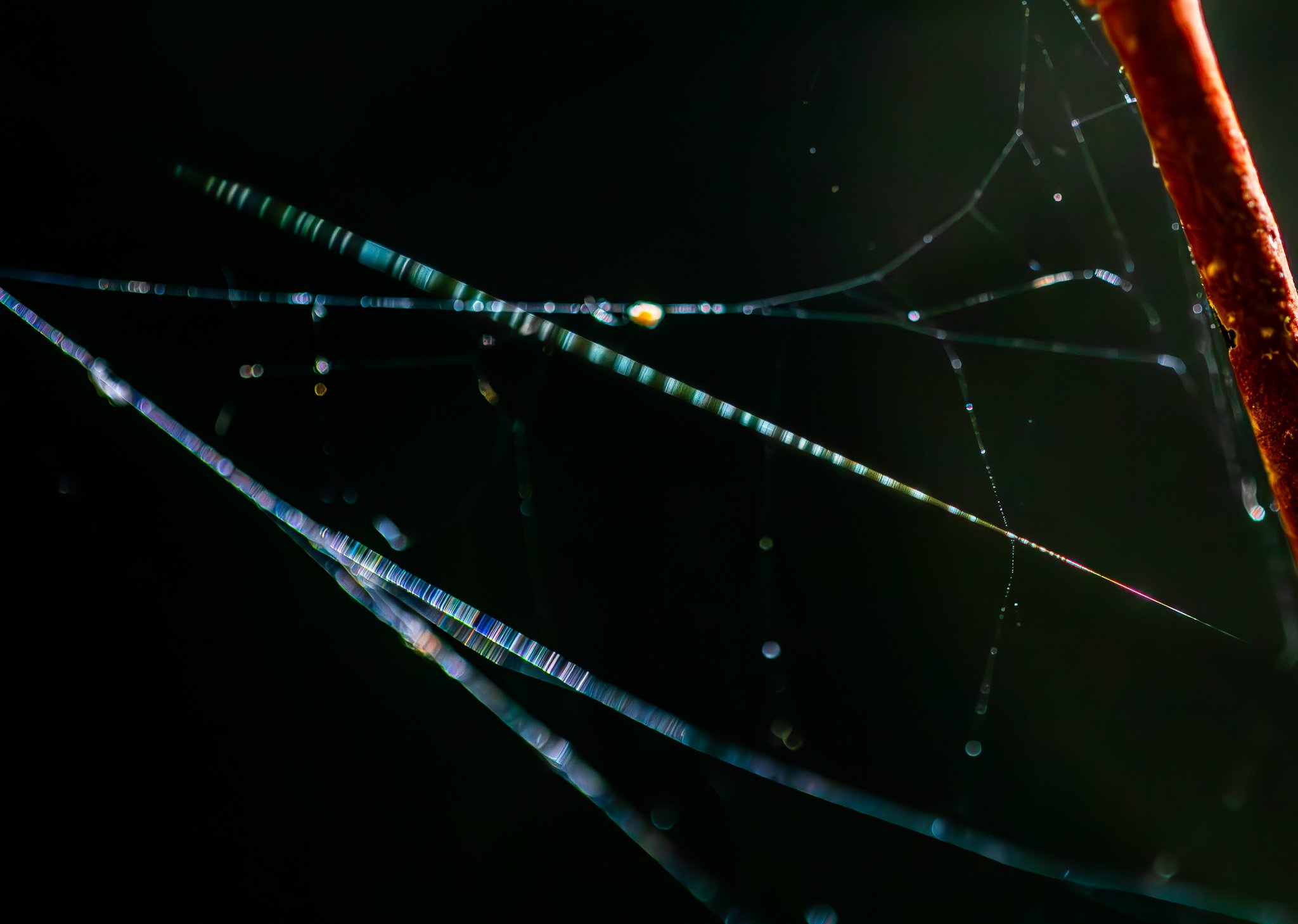
Threads Strung From Branches, Including a Triangle Web at Upper Right from A Triangle Web Spider.

Detail of Threads Strung From Branches
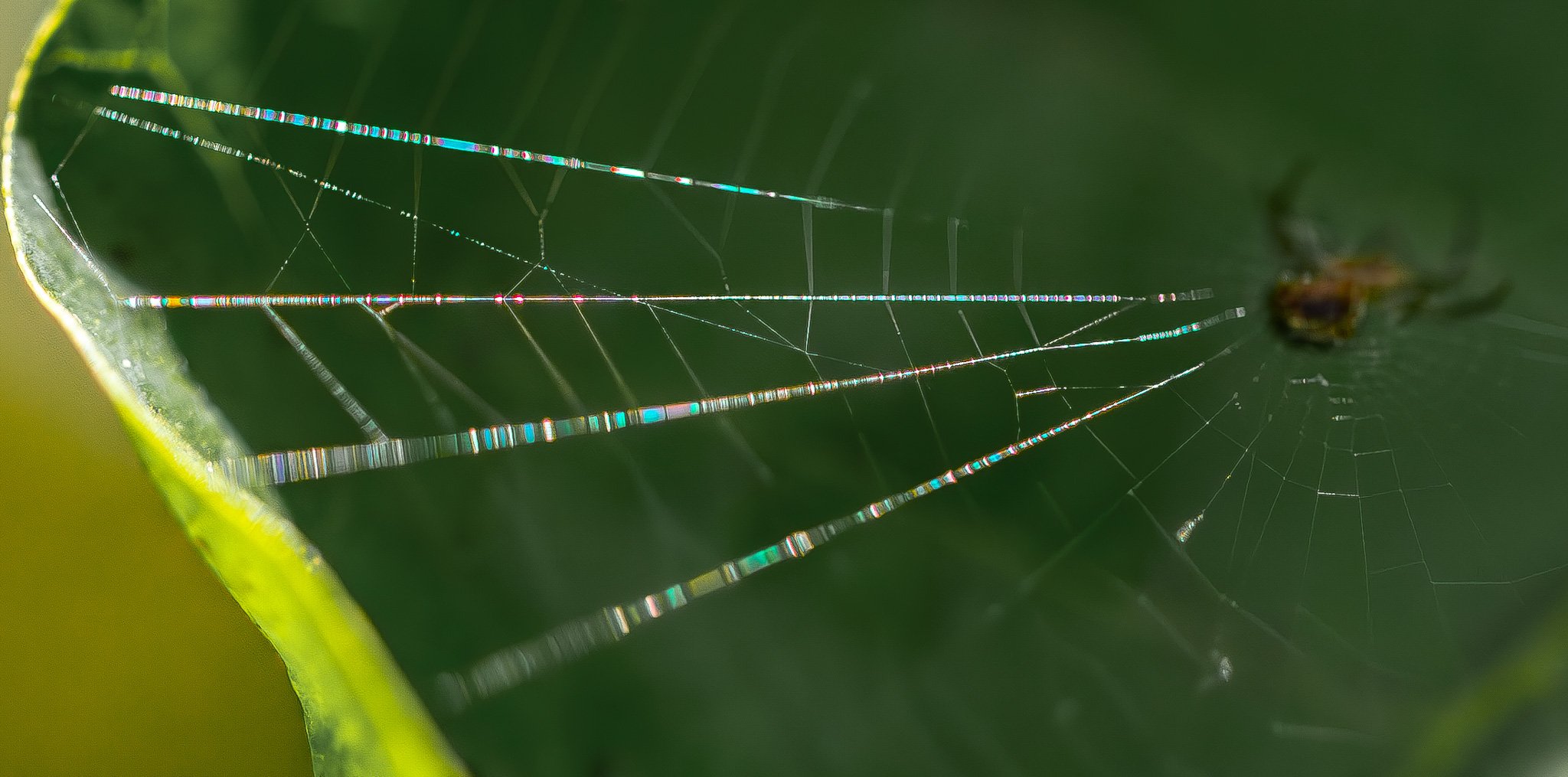
Sixspotted Orbweaver and Four Unfocused Threads: The threads progressively unfocused away from the spider.

Grass Spider Web in The Field: Each thread comprises a continuum of colored dots. The imaged area width was 3 cm.

Molt and Green Thread Within A Grass Spider Web: The green thread was about 6 cm long. Note the nearly evenly-spaced black bands.

Sixspotted Orbweaver Spider and Unfocused Thread: The unseen spots were on its back.

Capillary Fringes in Dew On A Grass Spider Web
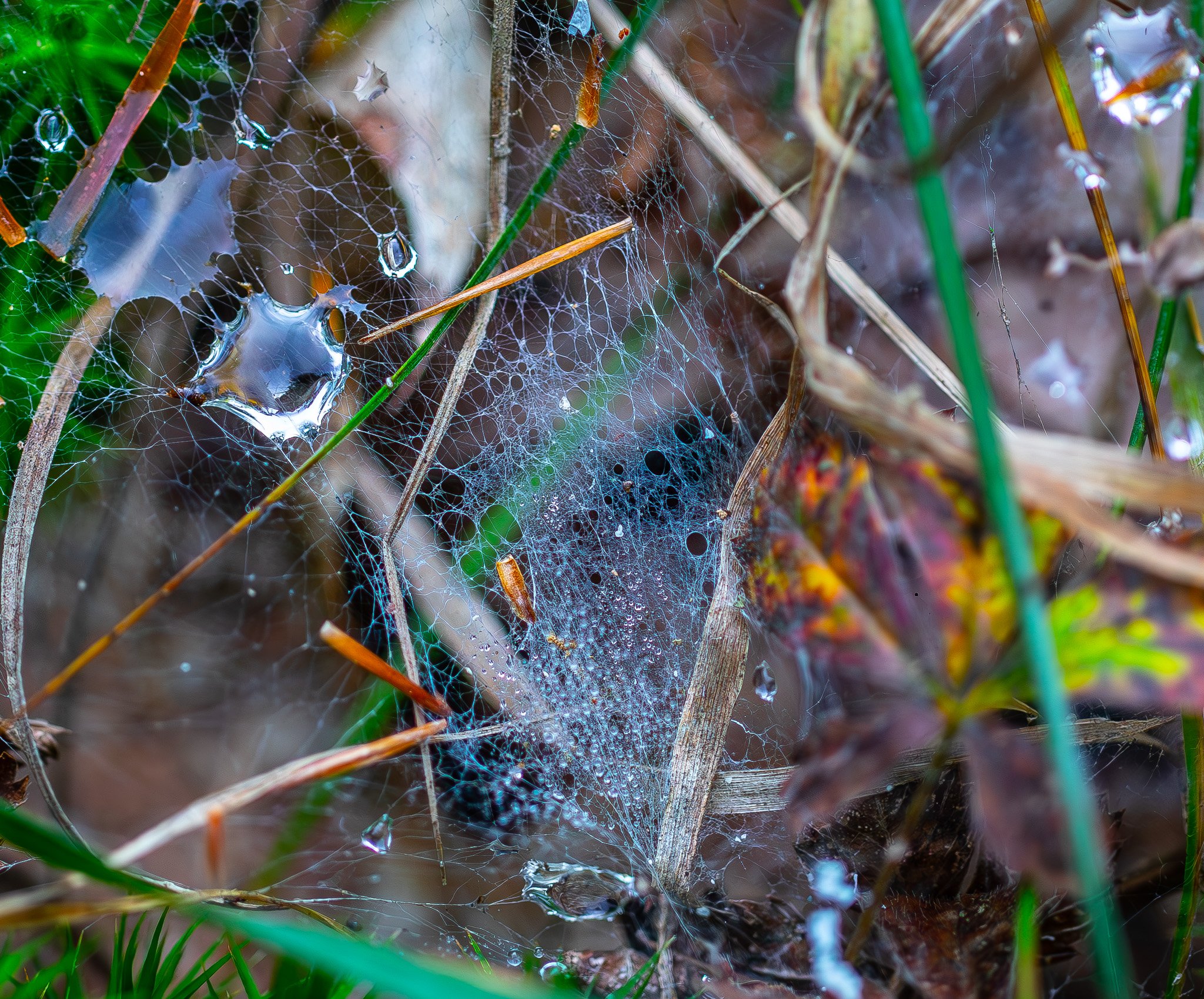
Blue Grass Spider Web With Large Dew Drops
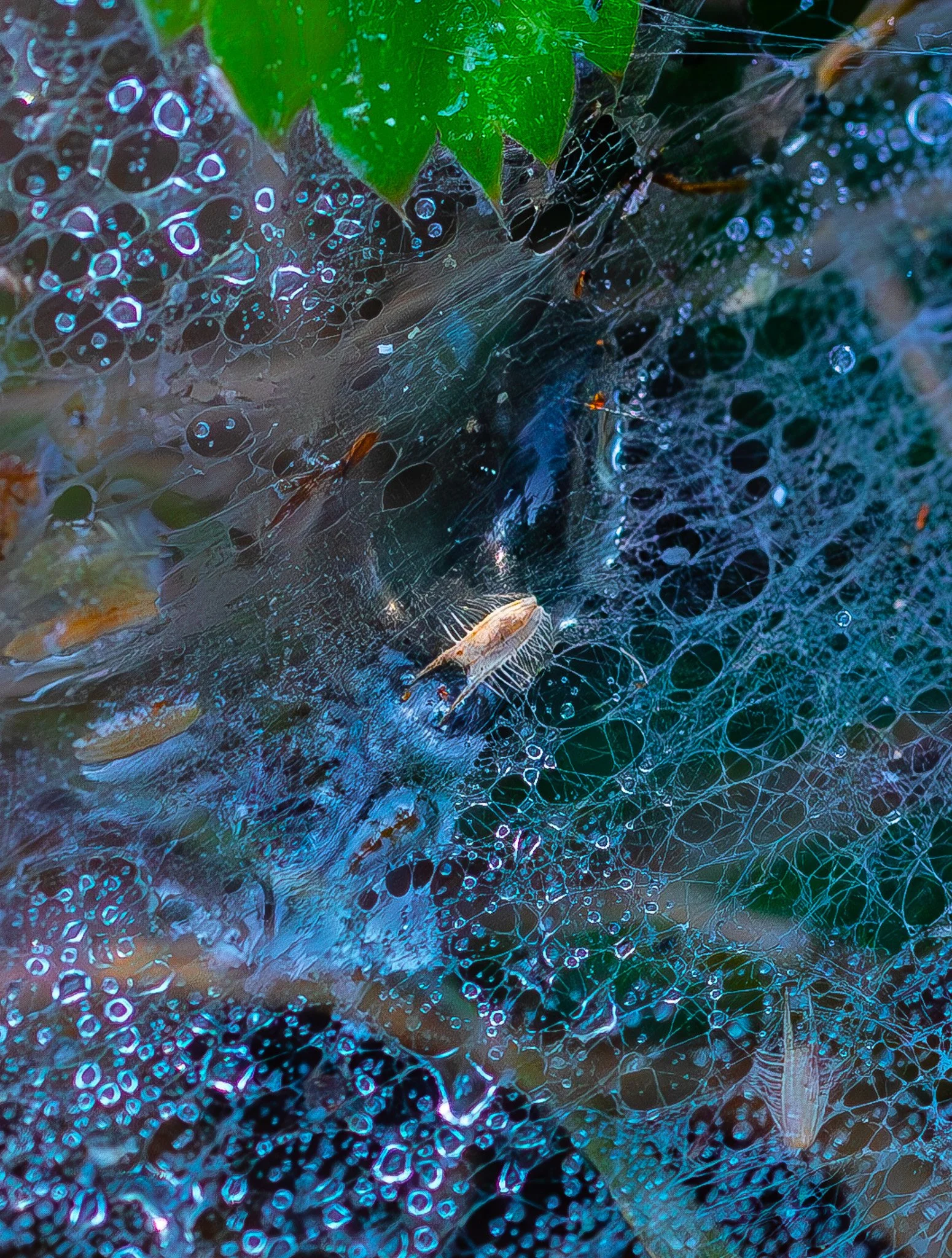
Blue Grass Spider Web With Seed
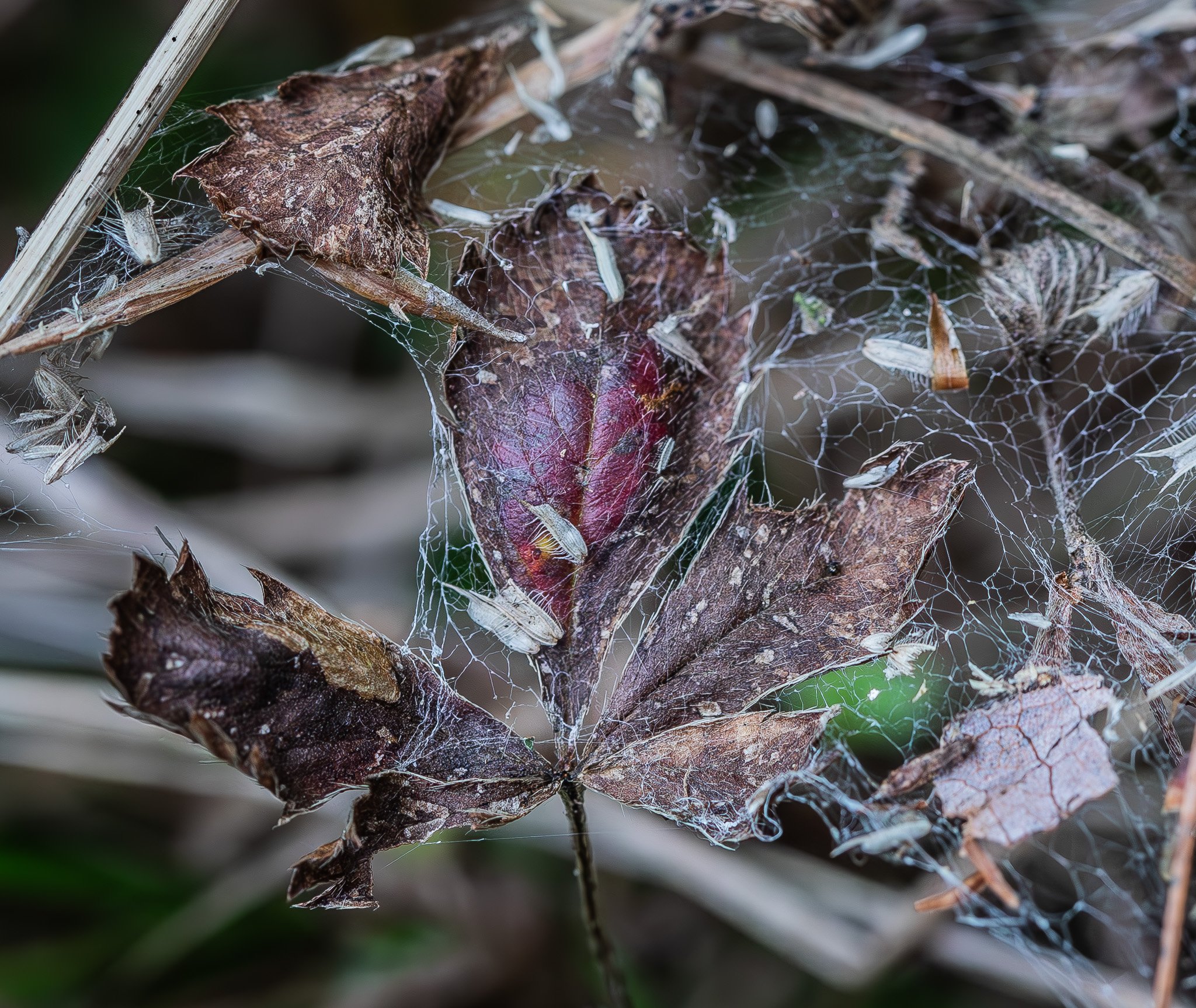
Grass Spider Web With Purple And Brown Maple Leaf
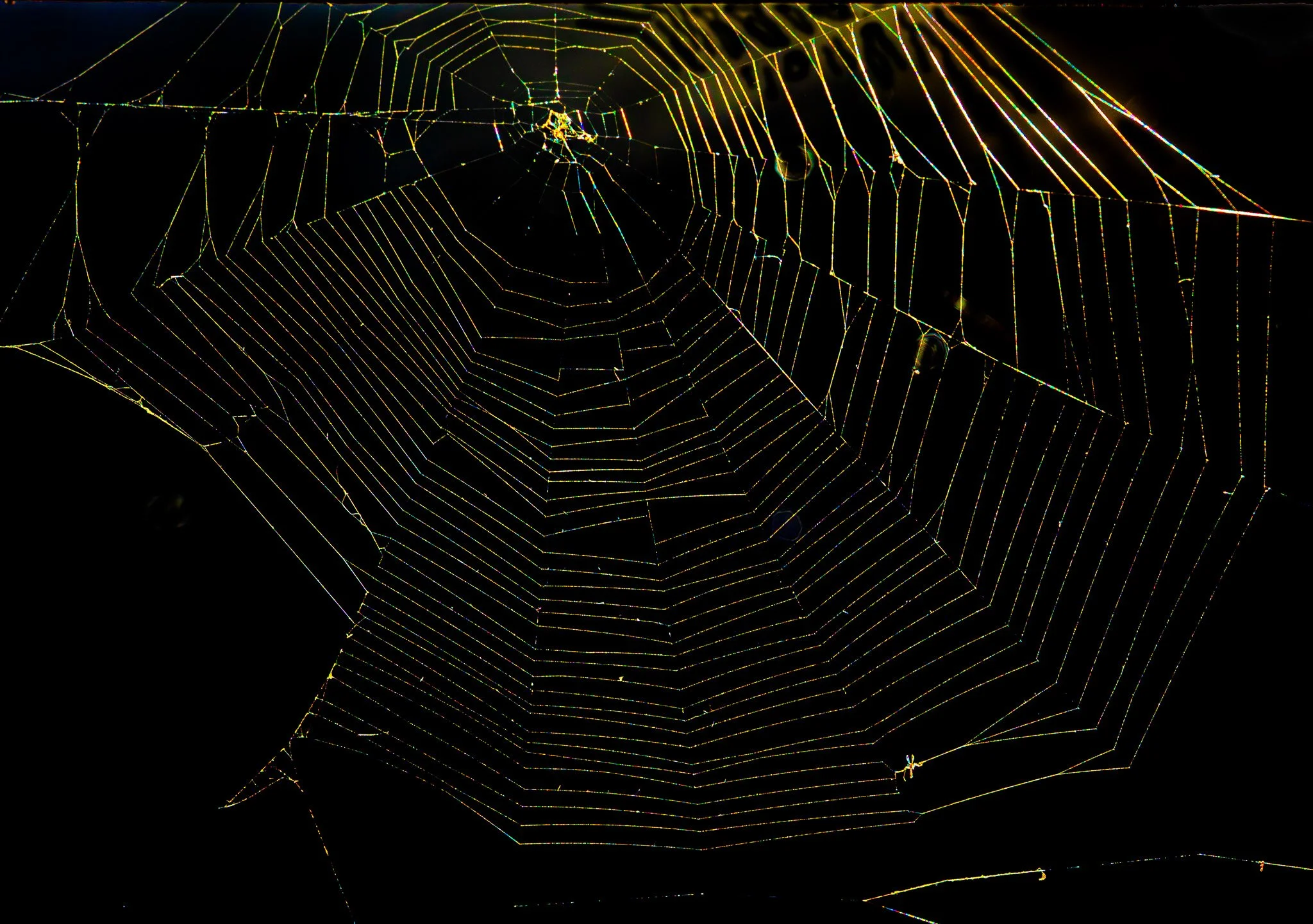
Web along the North Sutton Bridge in North Sutton, NH.: This orb web was strung vertically from the side rail. Both radial structure strands and orbital capture strands exhibit beads of color. The spider was likely in the origin but could not be identified.
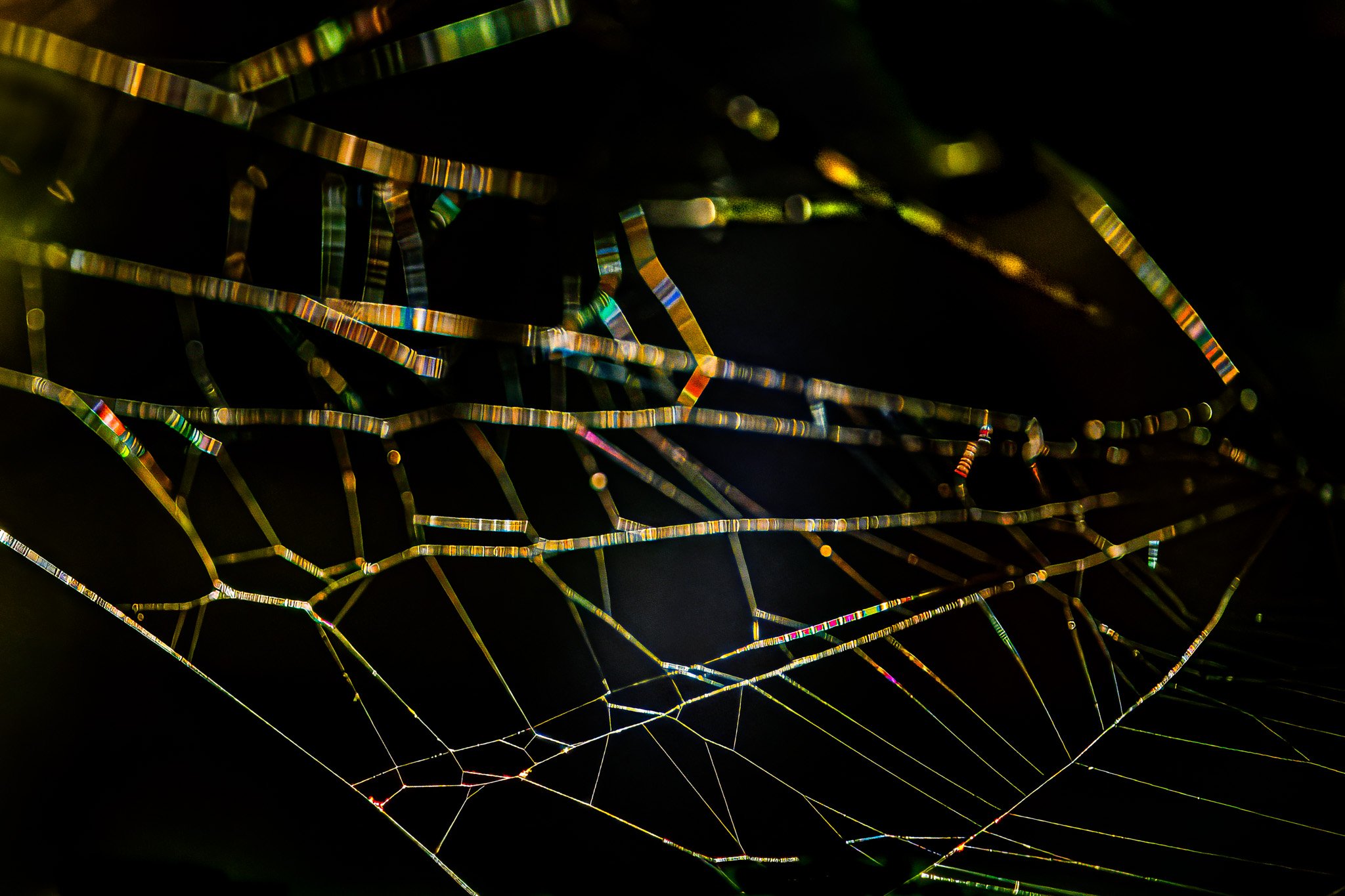
Garden Pond Web, River Road, Lyme, NH. I found this web in a private garden but available to the public. The web was actually over the pond, strung between plant stalks. The strands' colors are made obvious by being slightly out of focus. Unidentified spider.
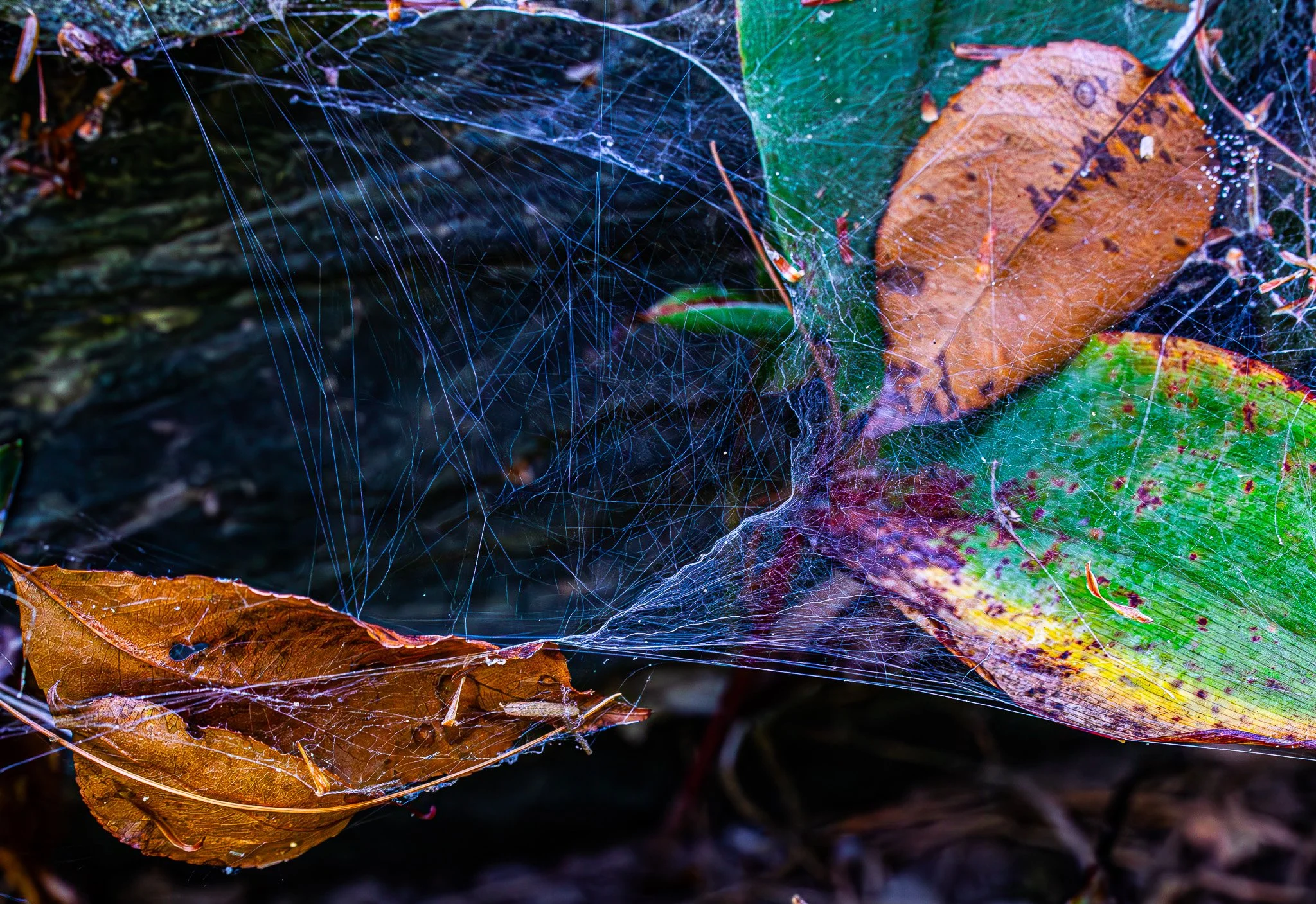
Grass spider web strung along small stone wall: This spider is a funnel web spider, which often makes its funnel in the curl of a leaf, in this case the brown one at left. The maze of overhead strands are meant to intercept insects, which then fall into the mesh and then captured by the fast moving spider.
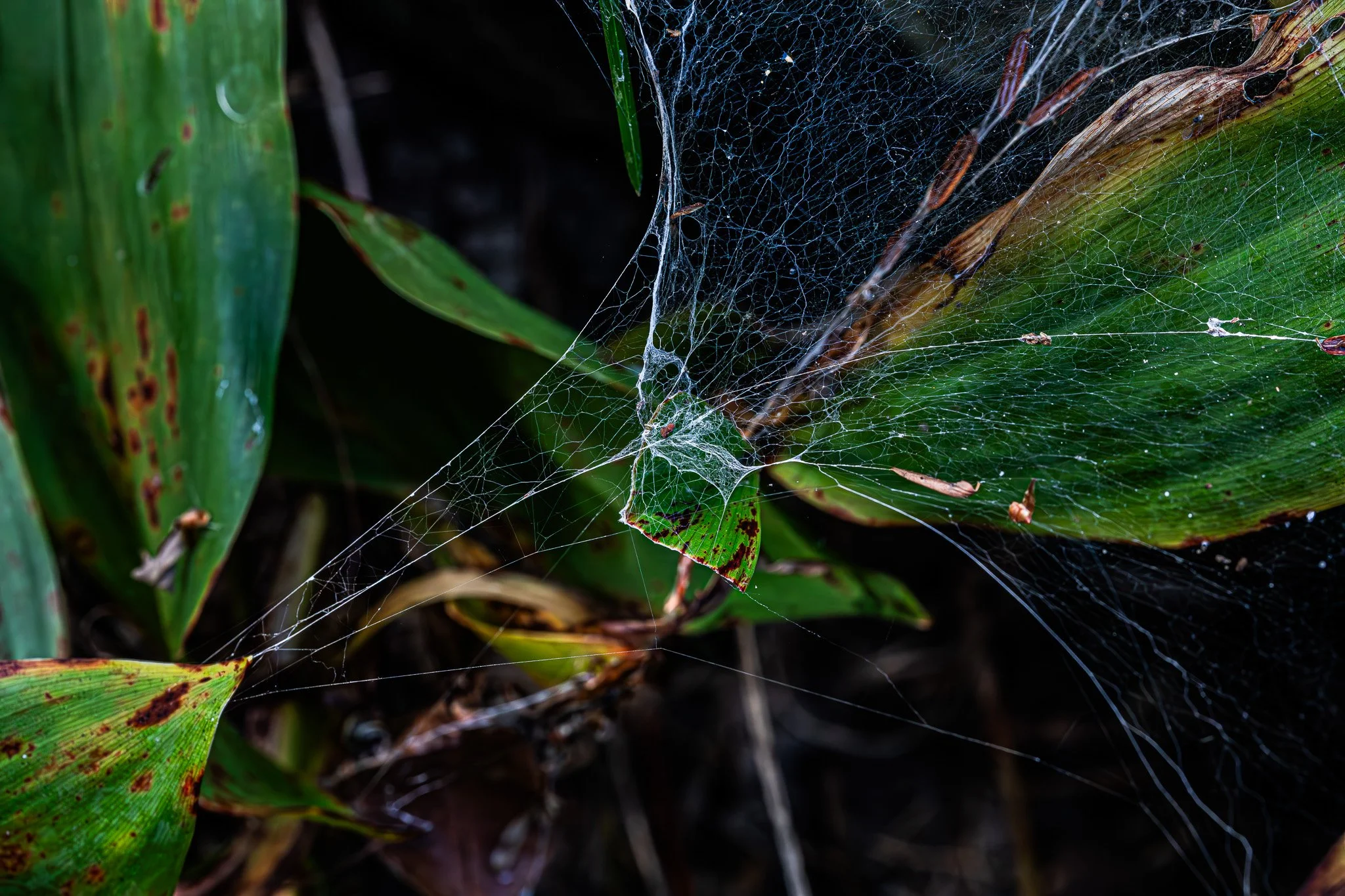
Another grass spider web along the same wall as in the previous image. The image shows mainly the capture mesh and not any overhead intercepting strands.
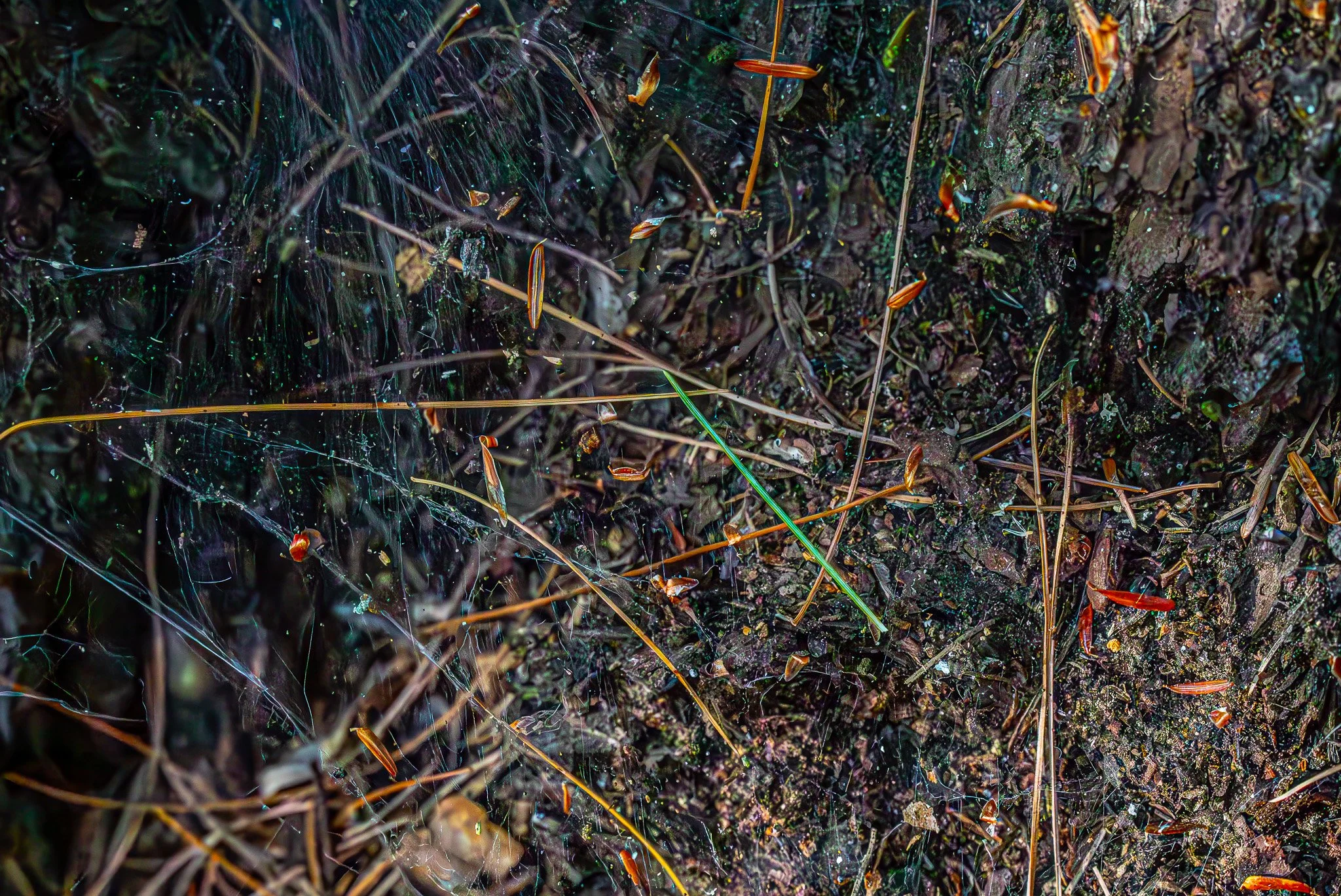
Trout brook silk and needles: I found this web section (mostly visible at left) in a hollowed-out and decaying tree trunk near Trout Brook, West Lebanon, NH.
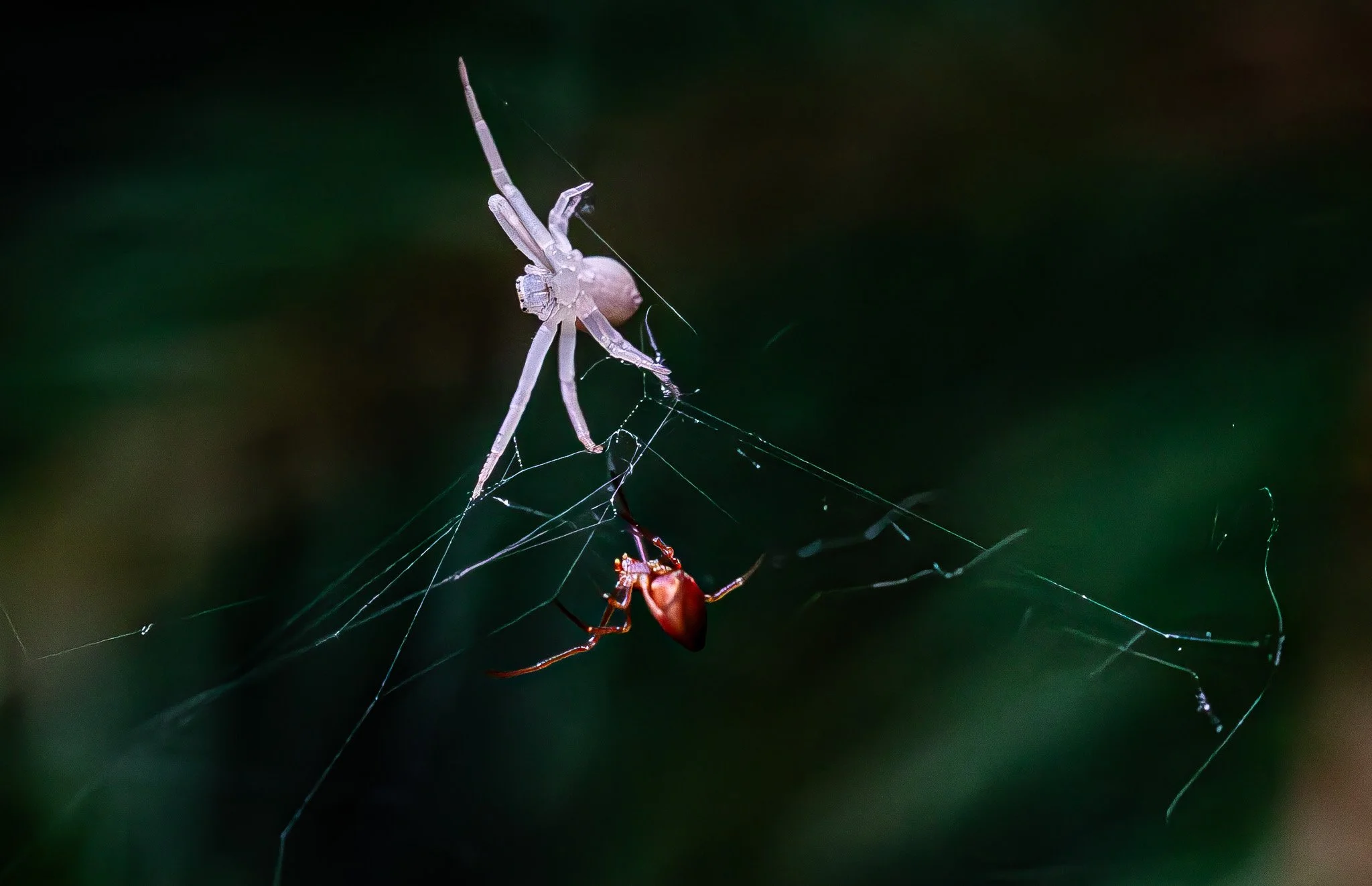
Crab spider and visitor: This scene was strung in a small, young fir tree. The visitor appears to be Neospintharus trigonum, a predatory spider that invades other’s webs. It has no common name. It fits every descriptor given for this species, including lack of leg banding. The apparent leg banding is too close to be the normal type seen on spider legs and may indicate the leg construction.
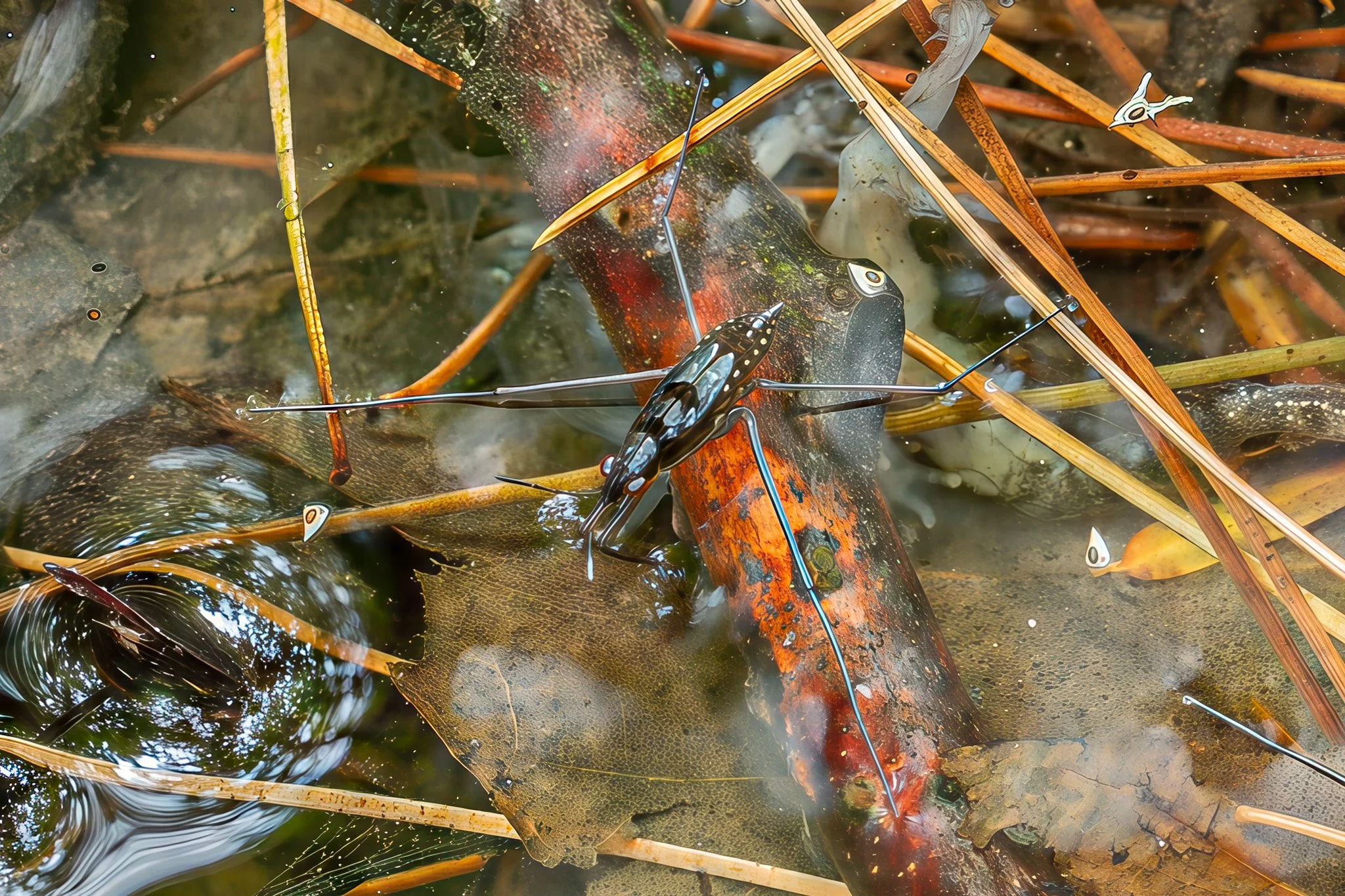
Common water strider: I believe this is the common water strider (Gerris remigis) although I cannot positively identify the markings in the National Audubon Society Field Guide to Insects and Spiders or on any strider I found on line. I photographed it on July 10, 2025, on Chambers Pond, in Chambers Memorial Reserve, West Lebanon, New Hampshire. There is much more “bio-pondology” that I can’t identify.